 English
  Chinese
 Español
 Français
 Русский язык
A box converter runs an AS‑A automatic high‑speed folder gluer at 300 boxes per minute. The first 1,000 boxes look perfect. Then the side seam starts slipping by 2 mm. The operator tweaks the glue pressure, then the fold rails, then the squaring section—and by the time the problem is fixed, 5,000 boxes are already in the reject bin.
The issue wasn‘t operator error. It was gradual calibration drift. A Folder-Gluer For Cardboard Box is a precision assembly of belts, rails, rollers, and sensors that must remain parallel, square, and synchronized. When these alignments shift—from vibration, wear, or material changes—the machine still runs, but quality degrades incrementally. The AS‑A series from New Rolam features motorized rail adjustment for faster fine‑tuning, but even the most advanced machine requires regular calibration to maintain ±0.3 mm folding accuracy.
This guide breaks down what calibration actually means on a folder gluer, why it directly affects your waste percentage and customer reject rate, and the schedule that keeps the machine producing at its rated accuracy.
Deconstructing “Calibration” for a Folder Gluer
It‘s Not Just About “Zeroing”
Calibration is not simply resetting a counter or pressing a “home” button on the touchscreen. On an automatic folder gluer, calibration encompasses three distinct domains: mechanical alignment, sensor adjustment, and timing synchronization. Mechanical alignment ensures rails are parallel; sensor adjustment ensures photoelectric eyes detect flaps at the correct moment; timing synchronization ensures belts and folding plates work together.
The 3 Critical Axes of Calibration
Parallelism (fold rails). The upper folding belt guides must be parallel to the lower carrier belt. Any deviation forces the carton to skew as it moves through the folding stations. A non‑parallel condition of just 0.3 mm over 1 meter of belt length can produce boxes that are out of square by several millimeters.
Perpendicularity (squaring). After folding, the box passes through a squaring section where rollers push the glued seam into alignment. If the squaring rollers are not perpendicular to the belt direction, boxes emerge with a “twisted” appearance—one corner higher than the opposite.
Synchronization (belt/carrier speeds). The glue nozzle must apply adhesive precisely when the flap passes underneath. A delay of 20 ms at 300 boxes/min shifts the glue pattern by 3 mm, causing weak seams or glue squeeze‑out. Photoelectric sensors track box position; their calibration ensures the glue shot coincides with the flap‘s arrival.
The “What” – A Checklist of Calibration Points
| Calibration Point | Tool | Target Specification | Frequency |
|---|---|---|---|
| Carrier belt tension | Tension gauge / deflection test | Even tension across full width, no sag | Daily |
| Upper folding belt guide rails | Feeler gauge, straightedge | Parallelism ≤0.3 mm over belt length | Weekly |
| Glue wheel eccentricity | Dial indicator | Runout ≤0.1 mm | Monthly |
| Glue wheel gap to applicator | Feeler gauge | 0.1–0.2 mm gap | Monthly |
| Tucking finger position (lock‑bottom) | Caliper, test box | Positions flap within ±1 mm | Weekly |
| Squaring section roller parallelism | Spirit level, straightedge | Perpendicular to belt, ≤0.2 mm/m | Monthly |
| Photoelectric sensor alignment | Test box, sensor target | Detects flap edge within 0.5 mm | Weekly |
| Glue pattern position (timing) | Test run, stop‑inspection | Centered on flap, no offset | Daily |
Modern folder gluers like the AS‑A series store calibration parameters in PLC memory. When a setup is saved for a specific box size, the machine automatically recalls rail positions, belt speeds, and glue timing. However, mechanical calibration—parallelism and squaring—must still be verified regularly.
The “Why” – Direct Impact on Production Metrics
Calibration drift is not an abstract precision issue. It shows up as three measurable production losses.
| Problem | Root Cause (Mis‑calibration) | Cost |
|---|---|---|
| Skewed boxes – box comes out of squaring section with one corner advanced | Fold rails not parallel | 3% waste increase |
| Dog‑ears – flap corners fold inward, creating crumpled appearance | Tucking fingers mis‑set or off‑center | Rework labor (hours per shift) |
| Inconsistent squaring – some boxes square, others not | Squaring section roller misalignment | Customer rejection (entire pallet) |
Skewed boxes occur when the box travels diagonally through the folding station. By the time it reaches the squaring section, the front and back edges are no longer aligned. For a line producing 100,000 boxes per shift, a 3% waste increase means 3,000 boxes rejected before they reach the palletizer.
Dog‑ears happen when tucking fingers contact the flap too early or too late, catching the corner instead of the leading edge. Operators must manually re‑fold each affected box, adding 15–30 seconds of handling per carton. Over a shift, that adds up to hours of lost productivity.
Inconsistent squaring results from roller misalignment or uneven belt wear. The roller applies pressure unevenly across the width, correcting some boxes while twisting others. The result: retail packaging that does not sit flat on the pallet or fails to run through automated case packing equipment. One rejected pallet can wipe out the margin for an entire week of production.
The “How Often” – A Time‑Based Calibration Schedule
Calibration is not a one‑time event. Box gluers operate in environments with constant vibration, temperature shifts, and belt stretch. A structured schedule prevents drift from becoming failure.
Daily Operator Checks
15 minutes. Before the first run of the shift, verify that glue is applied cleanly without offset. Run a test box, stop the machine mid‑cycle, and inspect glue pattern position relative to the flap. Check that feed belts move without slipping—a quick tug on the belt at the tension idler should feel firm but not rigid. Confirm that no obvious debris has accumulated on guide rails. These checks catch the 90% of calibration problems that are simple adjustments.
Weekly Precision Verification
30–60 minutes. Use a master test box—a known‑good carton of the most commonly produced size—to verify folding accuracy. Run it through at normal speed and measure the finished box diagonals; they should match within 2 mm. Inspect tucking finger positions; adjust if the fold starts more than 1 mm from the flap corner. Clean photoelectric sensors; dust accumulation is a frequent cause of intermittent glue timing errors. If belt tension has drifted, adjust to the manufacturer‘s deflection spec. At this frequency, calibration becomes predictive rather than reactive.
Monthly In‑Depth Calibration
2–4 hours. Perform a full parallel check of the folding rails using a straightedge. For a 1,000 mm‑wide rail, the gap variation should not exceed 0.3 mm. Use a dial indicator to measure glue wheel eccentricity; runout beyond 0.1 mm requires replacement or reconditioning. Verify squaring section roller parallelism with a spirit level placed across the squaring bed; adjust mounting brackets to bring the bubble level. Calibrate servo drives and encoders; confirm that the reported belt position matches actual mechanical travel. This level of calibration restores the machine to near‑factory condition.
Quarterly or Post‑Impact Full Calibration
8 hours. After any collision—a jam that required manual extraction or a foreign object strike—perform a complete recalibration. Also schedule quarterly full calibration regardless of observed issues. This includes checking the alignment of feed rollers, folding plates, and glue heads using a straightedge. Verify that glue nozzles are perpendicular to the belt and positioned at the correct height. Run a full test suite with a range of box sizes and document results. For machines under a service contract, the OEM may perform this level of calibration; verify that it is included.
Answering Your Folder Gluer Calibration Questions
Q: Do I need special tools to calibrate my automatic folder gluer? A: Yes, but the toolkit is modest and pays for itself quickly. A straightedge (1,000 mm length) and a set of feeler gauges are essential for checking rail parallelism. A spirit level verifies squaring section flatness. A dial indicator with a magnetic base is needed for glue wheel runout measurement. Calipers measure tucking finger positions and folded box dimensions. Most of these tools cost less than the scrap from a single shift of mis‑calibrated production.
Q: Can calibration compensate for worn belts or parts? A: No. Calibration restores alignment; it does not replace worn components. A belt with uneven stretch cannot be tensioned into perfect tracking. Glue wheels with grooves worn into the surface will always apply glue unevenly regardless of gap adjustment. Run a diagnostic test: if a component consistently drifts out of spec within days of calibration, replace it rather than recalibrating repeatedly. The AS‑A series uses wear‑resistant belts and hardened glue wheels, but all mechanical parts have finite life.
Q: How long does a full calibration take on a box glue machine? A: A daily check takes 15 minutes. Weekly verification, including sensor cleaning and test box run, requires 30–60 minutes. Monthly in‑depth calibration, including rail parallelism and squaring checks, takes 2–4 hours depending on machine width. Quarterly full calibration, including glue wheel runout measurement and servo drive verification, takes 8 hours. The AS‑A series‘s motorized rail adjustment reduces time for parallelism checks by 50% compared to manual adjustment.
Building a Calibration Culture in Your Plant
The most expensive calibration is the one you perform after a customer rejects an entire pallet. Shifting from reactive fixes to a proactive schedule requires three changes.
First, assign responsibility. Calibration is not “whoever is free.” Designate one trained technician as the calibration lead for each shift. That person owns the daily check and escalates issues to maintenance.
Second, document everything. Record calibration results, tool readings, and adjustments made. A logbook or digital spreadsheet becomes the baseline for spotting trends—for example, a rail that needs adjustment every two weeks may indicate a worn bearing or loose mounting bolt. The AS‑A series control system allows storing calibration parameters for different box sizes, but manual verification results should still be logged.
Third, make calibration part of the shift change. Include a calibration status update in the shift handoff. The incoming operator should know whether the machine passed the daily check, what adjustments were made, and what to watch for during the first test run. Accountability drives consistency.
Where the Machine Helps – Features That Reduce Calibration Frequency
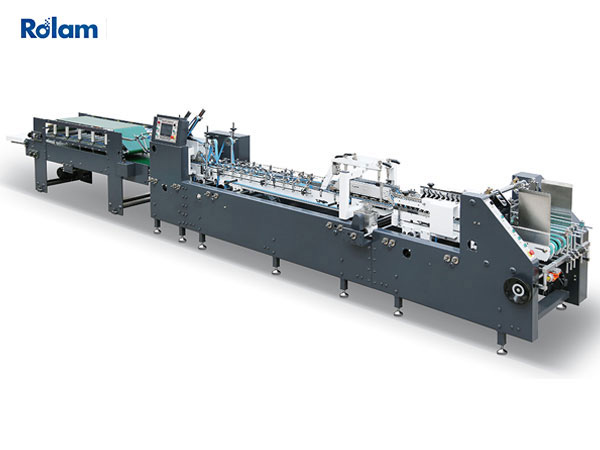
Modern folder gluers like the AS‑A Automatic Folder Gluer from New Rolam incorporate design features that maintain calibration longer. The AS‑A is a fully automatic high-speed folder gluer designed for precision box gluing, with motorized rail adjustment allowing operators to fine‑tune parallelism without loosening bolts—reducing time for checks by up to 50%. The heavy‑duty fabricated steel frame provides a rigid foundation that resists vibration drift. High‑precision ground rails maintain parallelism longer than standard rails. Integrated glue pattern inspection cameras catch misalignment immediately, alerting the operator before a full run of rejects is produced. The AS‑A processes cardboard from 210 gsm to 800 gsm plus corrugated B, N, and E flute, with maximum speed up to 400 m/min and production capacity up to 20,000 boxes per hour.
These features do not eliminate calibration, but they extend the interval between full recalibrations from monthly to quarterly for many box converters. With CE and ISO certifications, plus over 20 years of experience, New Rolam‘s AS‑A series provides consistent alignment under high‑speed operation.
→ Request a quote from New Rolam for the AS‑A Automatic Folder Gluer — Share your typical box sizes, material (board gsm or corrugated flute), and monthly production volume. Their technical team can recommend calibration tool sets and provide a training session for your operators on alignment procedures.