 English
  Chinese
 Español
 Français
 Русский язык
Your food packaging boxes need to do two things: stay glued together and stay safe. The glue that holds the box together must withstand handling, transport, and sometimes extreme temperatures—without compromising food safety.
For food packaging manufacturers, glue selection is a dual challenge: performance and compliance. Use the wrong adhesive, and your boxes fall apart. Use the wrong grade, and you risk non-compliance with food contact regulations. Your Folder-Gluer For Cardboard Box is capable of running at high speeds and delivering consistent results, but the glue you put through it determines whether those results are usable.
This article walks you through the key considerations for selecting glue for your folder-gluer line: understanding your food packaging’s risk level, the top contenders (water-based and hot melt), a simple decision flow to guide your choice, testing methods, and answers to common questions. For production and compliance managers in food packaging, this is a practical guide to getting the glue right.
Know Your Food‘s Risk Level
Not all food packaging has the same safety requirements. The first step is understanding your application’s risk level.
Direct Contact vs. Indirect Contact
Direct contact means the glue could touch the food—for example, a folded carton that holds dry cereal or a box that contains unwrapped baked goods. Indirect contact means the glue is separated from the food by a barrier—for example, a box with a plastic liner or a frozen food package where the food is in a sealed bag. If the glue has any potential for direct food contact, you must use a food-grade adhesive that complies with FDA regulations. For indirect contact, the requirements are less strict, but you should still confirm that the adhesive is suitable for food packaging use.
Temperature Considerations
Glue performance varies with temperature. Frozen food boxes need adhesives that remain flexible at low temperatures—standard water-based glues can become brittle and fail in a freezer. Hot-fill applications (foods packaged while hot) need adhesives that can withstand heat without breaking down. Ambient-temperature packaging (dry goods, cereal, snacks) has the widest range of options. The AS SERIES folder gluer from Rolam handles a range of paper weights from 200-600g/㎡, and the glue choice must match the temperature demands of your specific food product.
Water-Based – The Industry Standard
Water-based adhesives are the most common choice for food packaging boxes. Here’s why.
Why It‘s the Standard
Water-based adhesives are FDA-compliant for direct and indirect food contact. They have low VOCs (volatile organic compounds), are non-toxic, and are generally recognized as safe for food packaging applications. They’re also compatible with most paperboard substrates and don‘t require special handling. For the majority of food packaging applications—dry goods, cereal boxes, frozen food cartons—water-based glue is the default choice.
Matching Viscosity to Your Machine
The viscosity of the glue must match your folder-gluer’s application system. For standard folding cartons with good surface smoothness, aim for a viscosity around 1000-2000 cps. For highly porous recycled board, you may need a higher viscosity—3000-5000 cps—to prevent the glue from soaking into the board before it bonds. The AS SERIES folder gluer features a four-roller gluing system with a DC motor drive for precise glue application, giving you the control to match viscosity to substrate.
The “Too Thin, Too Thick” Problem
Glue that’s too thin soaks into the board and doesn‘t form a strong bond. Glue that’s too thick doesn‘t spread evenly and creates bumps or glue bleed on the box surface. Regular viscosity checks using a simple flow cup are recommended. Many water-based glues can be adjusted by adding small amounts of water—but never add water without measuring the viscosity first.
When to Consider Hot Melt
Hot melt adhesives are a specialty option for specific food packaging applications. They’re not the default choice, but they‘re worth considering.
The Speed and Instant-Bond Advantage
Hot melt adhesives set almost instantly—within seconds of application. This makes them ideal for high-speed production lines where water-based glues would need a longer compression section to cure. If your folder-gluer is running at high speed and you need immediate bond strength, hot melt may be the answer. The AS SERIES automatic high-speed bottom lock folder gluer is capable of running multiple box types at high speed—up to 400 m/min—and can accommodate hot melt systems.
Common Food Applications
Hot melt is commonly used for frozen food boxes (excellent cold-temperature flexibility), wine and beverage carriers (high strength and quick set), and microwaveable food packaging (heat-resistant). However, not all hot melts are food-safe—you must specify food-grade hot melt and check FDA compliance for your specific application.
The Cleanup Trade-Off
Hot melt doesn‘t clean up with water—it requires special cleaning solvents or heat-based cleaning. This is a consideration if you’re switching between water-based and hot melt on the same machine. Also, hot melt systems require heated hoses and applicators, which add to your equipment cost and maintenance requirements.
A Simple Glue Selection Decision Flow
Making a glue decision doesn‘t have to be complicated. Here’s a text-based decision tree to guide your choice.
Start at the Beginning
Start: Is there potential for direct food contact?
-
Yes: Your only option is a water-based adhesive that is FDA-approved for direct food contact.
-
No: You have more flexibility. Move to the next question.
Next: Does the package need to withstand freezing, hot-fill temperatures, or extreme conditions?
-
Yes: Consider a specialty hot melt adhesive designed for temperature resistance.
-
No: A standard water-based adhesive will work for most ambient-temperature food packaging.
Next: Is your production line running at high speed and do you need instant bond strength?
-
Yes: Hot melt provides the fastest set time and immediate handling strength.
-
No: Water-based adhesives are the most cost-effective and easy-to-handle option for most applications.
Testing and Validating Your Glue Choice
Selecting the right glue is only the first step. Testing confirms your choice works in production.
The Peel-and-Ply Test
After running a test batch on your folder gluer, take several finished boxes and manually peel the glued flap apart. A proper bond should tear the paper fibers before the glue joint fails—this is called “fiber tear.” If the glue joint separates cleanly without pulling any fiber, the bond is too weak. Adjust glue application amount, viscosity, or compression pressure and test again. The AS SERIES folder gluer’s upper and lower conveyor belts allow for quick pressure adjustments, making this testing process more efficient.
Environmental Stress Testing
Run finished boxes through conditions that simulate real-world use. Put them in a freezer overnight and test the bond the next day. Place them in a warm oven (50-60°C) for a few hours to simulate hot storage conditions. If the glue holds up to these tests, it‘s likely to perform in the field. If it fails, you’ve caught the problem before your customer does.
Production Monitoring
Monitor bond quality during production—not just at the start. Glue viscosity can drift as the machine warms up, and as glue is consumed from the tank. Check bond quality every hour on long runs, and adjust as needed. The AS SERIES features a full-color touch screen display for quick parameter adjustments, making these checks straightforward.
Questions Production Managers Ask
Do I need special cleaning procedures on my folder gluer after using food-grade glue?
Yes. Food-grade glues are not necessarily food-safe residues. After a run, flush the glue system and clean the applicator with the recommended cleaning solution for that adhesive. For water-based glues, plain water may be sufficient, but many suppliers recommend a mild cleaning agent. Always use the cleaning method specified by your glue supplier. Rolam provides detailed maintenance guidance for their folder gluers, including cleaning procedures.
Can I switch between water-based and hot melt on the same machine?
Yes—but it’s not a quick change. The glue application systems are fundamentally different: water-based systems use pumps, hoses, and applicators; hot melt systems use heated hoses and hot-melt guns. Switching between the two typically requires changing the application system, which can take several hours. Most converters choose one adhesive type and commit to it. If you need both, consider a dedicated machine for each adhesive type. The AS SERIES can be configured for different application systems, but the specific setup should be discussed with the supplier.
What documentation should I request from my glue supplier for FDA compliance?
Request a Food Contact Compliance Statement that confirms the glue meets FDA regulations for the specific food contact scenario (direct or indirect). Also request the current FDA regulation number (e.g., 21 CFR 175.105 for adhesives). The statement should include the glue’s intended use, the maximum temperature it can withstand, and any limitations on food types. Rolam supports customers with comprehensive technical documentation for their folder gluer lines, but glue documentation must come from your adhesive supplier.
Building a Glue Knowledge Base
Glue selection isn‘t a one-time decision—it’s an ongoing process of matching adhesive to substrate, machine, and application.
Document What Works
Keep a record of glue specifications that work for each of your box types. Record the glue type, viscosity, application temperature, and substrate. When you run the same box again, you can set up faster. The AS SERIES folder gluer’s full-color touch screen display can save different recipes for quick recall.
Train Your Operators
Make sure operators know how to check glue viscosity, how to clean the applicator, and what a good bond looks like. Glue-related problems are some of the most common production issues—and they’re usually preventable with proper training. Rolam provides on-site training and technical guidance to support operator skill development.
Keep a Supplier Relationship
Build a relationship with your glue supplier. They can recommend products for new substrates, help troubleshoot application problems, and provide regulatory documentation. For food packaging, the regulatory environment changes—your supplier should be your partner in staying compliant.
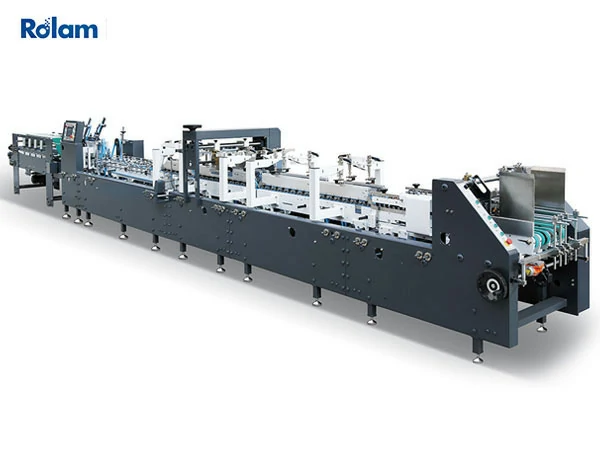
Rolam has been designing and manufacturing folder gluers since 2006, with a wealth of experience in the field. The AS SERIES Automatic High Speed Bottom Lock Folder Gluer is built for highly productive operation up to 400 m/min, handling paper weights from 200-600g/㎡. It features a four-roller gluing system with DC motor drive for precise glue application, upper and lower conveyor belts for quick pressure adjustment, and a full-color touch screen display for easy operation. The machine is compatible with a range of glue types, including water-based and hot melt adhesives.
Rolam‘s commitment to quality starts with raw materials—all steel meets ISO 9001 and ISO 14001 certification standards. The assembly team has more than a decade of experience, and the company provides one-on-one technical guidance, detailed video tutorials, remote technical support, and 24/7 customer service. For converters entering the food packaging market, this level of support is essential.
Selecting the right glue for your food packaging box is a balance of safety, substrate compatibility, and machine performance. Start by understanding your food packaging’s risk level: direct or indirect food contact. Then choose between water-based adhesives (the industry standard for food boxes) and hot melt adhesives (the choice for high-speed or temperature-demanding applications). Test your choice with peel-and-ply and environmental stress tests, and build a knowledge base that makes future decisions easier. With the right glue and the right folder-gluer, your food packaging boxes will be strong, safe, and production-ready.
Ready to optimize your glue selection for food packaging? Reach out to Rolam’s technical team—they can provide glue application guidance, viscosity recommendations, and machine configuration support for your food packaging production needs.