 English
  Chinese
 Español
 Français
 Русский язык
E-commerce packaging isn’t retail. One order needs fifty RSCs for sneakers; the next runs a hundred thin micro-flute mailers for cosmetics. Changeovers are constant, deadlines are brutal, and the machine can’t stop.
Running a Folder-Gluer For Cardboard Box in this environment means rethinking every setup. The substrate varies wildly — from lightweight E-flute to double-wall BC. The box styles shift between standard RSCs and multi-corner e-commerce designs. And the adhesive needs to hold securely without soaking through thin board.
This guide walks through feeder adjustments for mixed board grades, glue system calibration for clean seams, squaring fixes for RSC stability, and handling micro-flutes without crushing. Consider it your field manual for keeping e-commerce lines profitable.
RSC Specs and Flute Challenges — What Your Gluer Needs to Handle
Regular slotted cartons dominate e-commerce for good reason: single-wall construction, flaps meeting at the center, easy assembly, and excellent stacking strength. But RSCs create two specific folding challenges.
First, long flaps can catch on folding rails before entering the folding section, causing jams or misaligned boxes. Second, e-commerce board is often thin — B-flute at about 3mm, E-flute at 1.6mm, F-flute at 0.8mm, and N-flute under 0.5mm. Excessive feed wheel pressure crushes these delicate flutes.
Feed Wheel Pressure by Flute Type
| Flute Type | Thickness | Feed Pressure | Key Risk |
|---|---|---|---|
| B-flute | ~3.0mm | Low | Crushing, poor feed |
| E-flute | ~1.6mm | Medium-low | Edge crush, distortion |
| F-flute | ~0.8mm | Light | Flute collapse |
| N-flute (micro) | <0.5mm | Minimal | Total collapse |
| Double-wall BC | ~5-7mm | Medium-high | Skewing |
The takeaway? Know your flute before you feed. One pressure setting does not fit all.
Feeder Adjustments for Mixed Board Grades — Getting It Right the First Time
Different flutes behave differently. B-flute needs firm grip but not crushing pressure. E-flute and F-flute need a lighter touch. N-flute (micro) demands minimal contact — just enough to pull the board without collapsing the structure.
Many modern folder-gluers offer no-mold adjustment designs that eliminate physical tooling changes. Before running a new material stack, verify that side gates are perfectly parallel. Misaligned gates cause skewing, which leads to poor folding and glue application failures.
For thin micro-flute, reduce feed belt pressure below your standard setting and increase vacuum assist if your machine has it. For double-wall BC (common for heavy shipments), ensure feed belts aren’t slipping. Add drive tension if boxes hesitate at the entrance.
Here’s a practical tip: keep a laminated card at the feeder with baseline pressure settings for each flute type. Your operators will thank you during rushed changeovers.
Glue System Mastery — Clean Seams Without Smearing
E-commerce boards, especially thin micro-flutes, are unforgiving when it comes to adhesive. Too much glue soaks through and causes staining or waviness. Too little, and the seam fails during filling or transit.
Start by setting the glue wheel gap to just enough to transfer a uniform film — roughly 0.05mm below sheet thickness as a baseline. Then run a test box and adjust.
For cold glue on corrugated, monitor viscosity daily. Temperature changes thicken or thin the adhesive, which alters spread patterns. A simple viscosity cup check takes two minutes and saves a lot of scrap.
The glue nip timing matters critically. Application should occur late enough to avoid smearing during folding but early enough to allow the adhesive to wet out before compression. Three-gun systems, standard on machines like the LC-S series from Rolam, allow precise zone control for 4/6 corner boxes. For small RSCs, a single centered bead works well. For larger boxes with long flaps, staggered glue placement prevents pop-opens.
Solving the Pop-Open Problem at E-commerce Speeds
Nothing kills productivity like boxes springing open after compression. You hear the pop, then watch a dozen boxes unfold on the conveyor. It’s frustrating, but fixable.
First, verify compression section length. Boxes need adequate compression time for the bond to set. If pop-opens persist, increase compression length or slow belt speed in that section. Fifteen seconds of compression is a good minimum for cold glue.
Second, check your adhesive. Cold glue requires 15–30 seconds of compression; hot melt sets in seconds but needs the right temperature (typically 150–180°C for EVA-based formulas). If you’re using hot melt, verify the applicator temperature matches the adhesive spec sheet.
Third, ensure the glue pattern is continuous. Intermittent application due to dirty nozzles or inconsistent pump pressure is the most common hidden cause of pop-opens. Clean nozzles at the start of every shift.
Fast Fixes for Flap Tuck Failures
Small flap tuck-in failures usually trace to pre-fold timing. RSCs require flaps to be folded slightly past 90° so they snap into place. If tucking fails, increase the pre-fold angle incrementally — try 5 degrees at a time.
Also verify that folding belts aren’t slipping. Worn belts create inconsistent leading edge positioning, which makes the flaps miss their tucking targets. Replace belts annually in high-volume environments.
Squaring for RSC Stability at High Speed
A box that isn’t square won’t stack well, won’t seal properly on the case erector, and won’t survive shipping. The squaring section is where the magic happens — it should bring both sides of the box into alignment before final compression.
Look for machines with integrated rear stack correctors that align RSC boxes pneumatically. These correctors push the trailing edges into position while the folding belts hold the front.
Belt synchronization matters enormously. If left and right folding belts run at slightly different speeds, fisheyeing appears — one side moves ahead of the other, creating a parallelogram instead of a rectangle. Set independent side speed controls identically, and check synchronization weekly with a tachometer.
Also verify that compression belts are applying even pressure across the width. Use a thickness gauge at multiple points. Uneven pressure creates twisted boxes.
Handling E-commerce-Only Problems — What the Manuals Don’t Mention
Three issues appear almost exclusively in e-commerce workflows. They aren’t covered in most operator manuals, but you’ll encounter them.
Micro-flute crushing. When feed wheels and folding rollers haven’t been recalibrated for ultra-thin material, the flutes collapse. The fix: reduce all contact pressures by 30–50% from your E-flute baselines, and use wider belts to distribute the load.
Static cling. Especially in dry winter air or with recycled board, static causes blanks to stick together, double-feed, or misfeed. Install anti-static bars or even simple tinsel across the feed table. Grounding the machine properly also helps.
Warped board. Warehouse humidity swings cause board to warp. Store material flat on pallets and let it acclimate for 24 hours before running. Minor warpage can be overcome with increased side gate pressure, but severe warping requires rejecting the batch.
Quick-Changeover Best Practices for Mixed SKUs
E-commerce demands fast changeovers. That’s where modern machine features pay off.
Use memory settings. Store job profiles for each box type — dimensions, flute, glue pattern, speed — in the machine control. On the LC-S from Rolam, recalling a profile takes seconds.
Use quick-release lock mechanisms on folding rails and side guides instead of bolt-tightened systems. The difference between a wrench and a lever is minutes per changeover, which adds up to hours per week.
Standardize glue nozzles. Magnetic-mount nozzles allow repositioning without tools. Keep a second set pre-configured for your most common box sizes.
Train operators on a consistent sequence: load job profile, adjust side gates, verify feed pressure, test glue pattern on scrap, then run first five boxes for inspection. A disciplined five-minute routine replaces 30 minutes of trial and error.
Putting the LC-S High Speed Automatic Folder Gluer to Work
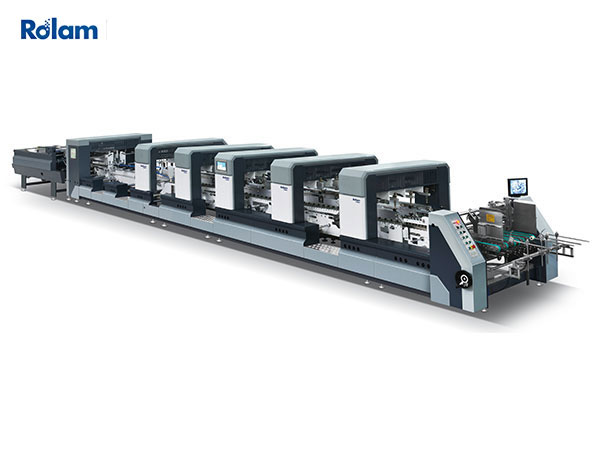
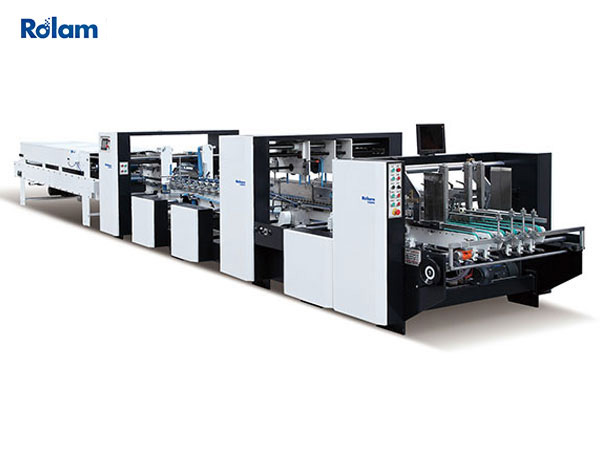
When e-commerce volumes demand both speed and flexibility, the LC-S High Speed Automatic 4 and 6 corner Folder Gluer from Rolam delivers.
Running at up to 400 m/min and handling 210–800 gsm cardboard plus B, N, and E flute corrugated, it’s built for mixed e-commerce workflows. The no-mold adjustment design cuts changeover time dramatically. The three-gun glue system handles complex 4/6 corner boxes and standard RSCs with equal ease.
Multi-stage correction and squaring ensure precise alignment before final compression. Eco-friendly water-based glue with wireless remote control keeps the line green and smart. Rolam brings over 20 years of experience, CE and ISO certifications, and provides installation, training, and ongoing technical support.
In short: if you’re running high-mix e-commerce boxes, this machine belongs on your floor.
Your E-commerce Optimization Checklist
Before you start the first box of a shift, run through these five checks:
-
Feed wheel pressure — match it to the flute (B vs. E vs. N). Use your laminated reference card.
-
Glue wheel gap — confirm with a feeler gauge. Target: 0.05mm below board thickness.
-
Glue pattern — test on scrap. Look for a uniform bead, no gaps, no smearing.
-
Compression section — verify belt speed allows adequate compression time for your adhesive type.
-
Squaring alignment — test with a sample box. Measure diagonals; they should match within 2mm.
Follow these steps, and you’ll catch 90% of setup issues before they become production problems.
【Request a quote from Rolam for the LC-S High Speed Automatic 4 and 6 corner Folder Gluer】 — Share your monthly e-commerce box volume, typical flute types (B, E, F, N), and average RSC sizes. Their technical team will recommend configuration options and can schedule a live demo.